
“`html
📖 Estimated reading time: 12 minutes
Creating a dream home isn’t just about picking out pretty tiles; it’s about a strategic approach to functional living. At Visual Chase Interiors and Decor, we’ve always believed the kitchen is the true heartbeat of any home. Getting your modular kitchen planning right is the first step toward a space that actually works for you rather than against you.
In simple terms, a modular kitchen is just a layout of pre-made cabinet modules, but don’t let the simplicity fool you. While many people get caught up in debating color palettes, the real win is in the technical workflow. I’ve found that the most beautiful kitchen in the world is useless if you’re tripping over your own feet to get to the fridge. In this guide, I’m sharing the secrets we use to turn standard cooking areas into high-performance culinary studios.
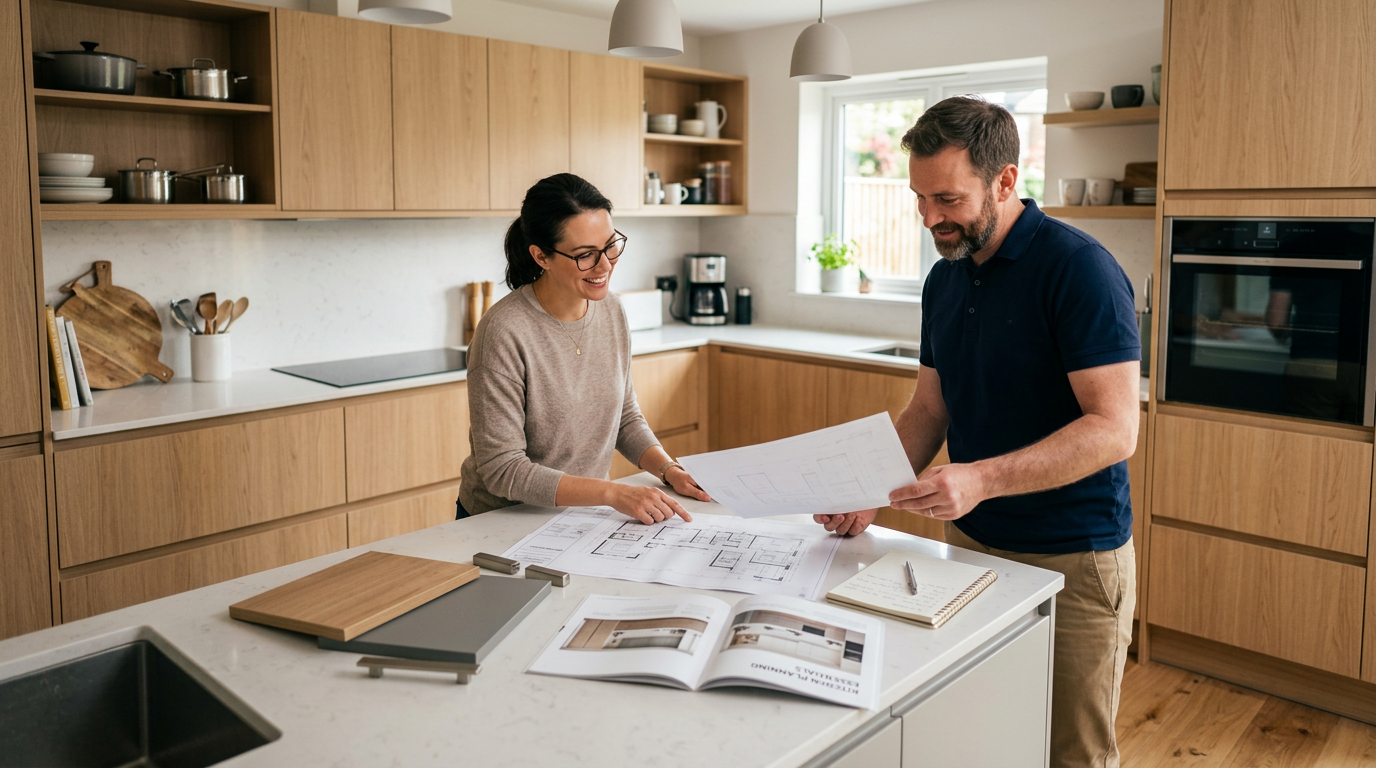
1. Master the Golden Triangle for Efficiency
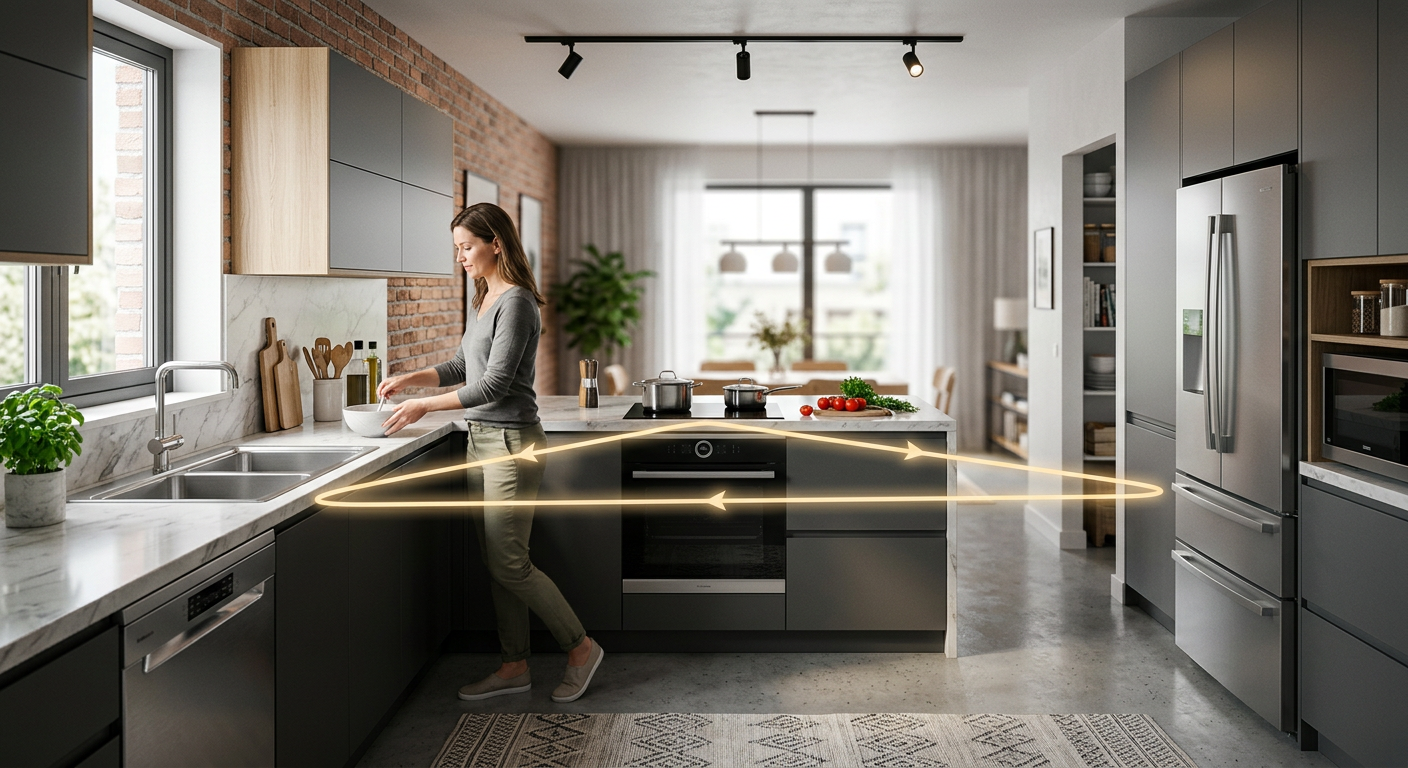
The backbone of any solid modular kitchen planning project is the “Golden Triangle.” If you haven’t heard of it, think of it as the choreography of your cooking. This rule dictates where you place the three kings of the kitchen: the sink, the stove (hob), and the fridge. When these are mapped out correctly, you spend less time running laps around your island and more time actually cooking.
The goal is to have these three points form a triangle with legs between 4 and 9 feet. Here’s the thing: if they’re too close, you’ll feel like you’re in a cage. Too far apart? You’ll be exhausted before the onions are even sautéed. In my experience, a failed ergonomic kitchen layout almost always starts with a triangle that’s either too stretched out or awkwardly cramped.
By sticking to this flow, you’re making sure the path between cleaning, prep, and storage is wide open. It’s all about cutting down the physical grunt work. When you’re looking over your modular cabinetry guide, make sure you don’t stick a massive pantry unit right in the middle of that path.
2. Ergonomics: Design Around Your Body, Not Industry Standards
Most people assume there’s a “one size fits all” height for countertops, usually around 34 to 36 inches. But why design for an average when you aren’t average? At Visual Chase Interiors and Decor, we love the “elbow test.” Stand naturally and bend your elbow; your countertop should sit about 10 to 15 centimeters below that. This kind of personalization is a non-negotiable for a professional kitchen renovation checklist.
Let’s talk storage. Ever noticed how annoying it is to dig for a heavy pot at the back of a low shelf? Follow the “Golden Rule”: put the stuff you use every single day—spices, knives, your favorite pan—between your hip and shoulder height. Heavy, festive platters can live in the bottom drawers, and those “light as air” Tupperware containers belong in the top cabinets of your modular cabinetry guide.
- Zone 1 (Frequent Use): Hip to shoulder height (70cm to 160cm). Keep the basics here.
- Zone 2 (Occasional Use): Down low (below 70cm). Perfect for those heavy cast-iron pots.
- Zone 3 (Rare Use): Up high (above 160cm). Save this for the holiday dishes you see once a year.
Don’t spend your life bending over or hunting for a step stool. A smart kitchen renovation checklist keeps your back and joints happy for years. It’s the secret sauce of modular kitchen planning.
3. The Show Kitchen vs. Wet Kitchen Duality
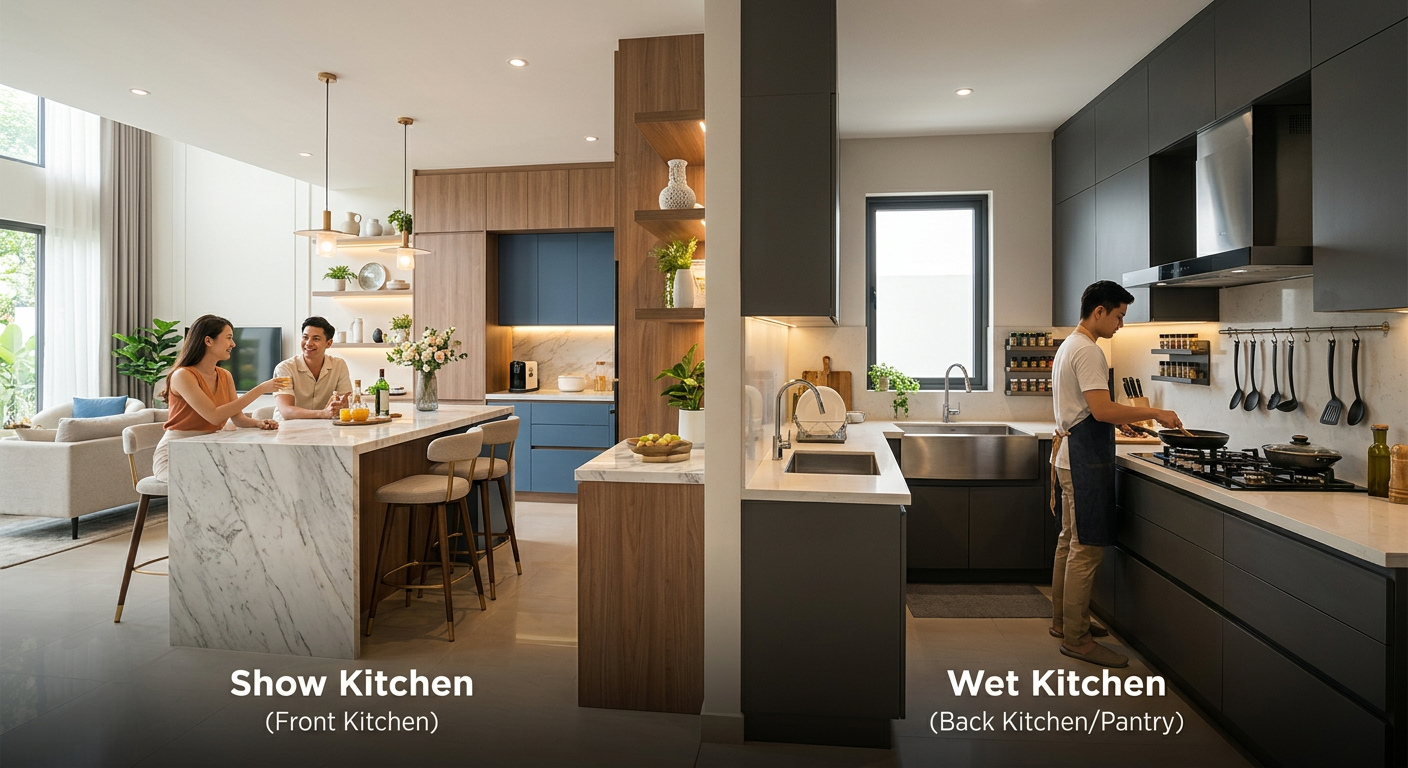
There’s a shift happening in home design where we separate the “Show Kitchen” from the “Wet Kitchen.” Let’s be real: sometimes cooking is messy. If you’re someone who loves to host, this modular kitchen planning strategy is a game-changer. It allows you to keep the “performance” area looking like a magazine cover while the heavy lifting happens behind the scenes.
The Show Kitchen is typically your open-plan stunner. It’s all about high-end aesthetics and custom kitchen fittings for wine chilling or light snacks. Then you have the Wet Kitchen, usually tucked away. This is where the real grease and steam happen. [INTERNAL LINK: Space-saving kitchen furniture ideas]
This layout keeps your living room from smelling like fried fish and hides the pile of dishes from your guests. It’s a smart way to use delicate, pretty materials in one area and industrial-strength, durable stuff in the other during your modular kitchen planning. It also lets you get really creative with your pantry unit design.
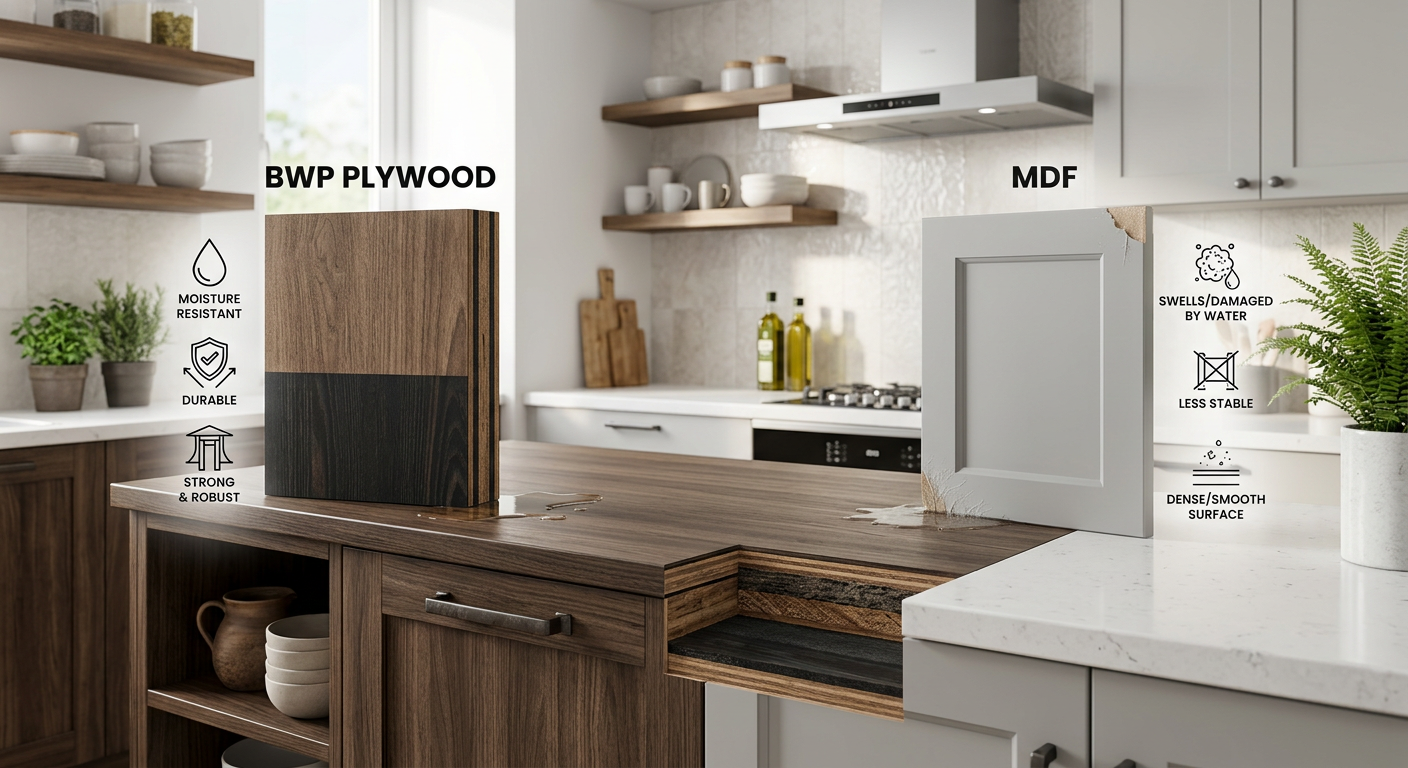
4. Material Science: Why BWP Plywood Trumps MDF
This is probably the most important decision you’ll make during modular kitchen planning. While MDF or Particle Board might look tempting because they’re cheaper upfront, they’re basically sponges when they meet water. A good modular cabinetry guide will tell you to skip the “savings” here and invest in quality.
In a kitchen—where steam, spills, and humidity are constant residents—BWP (Boiling Water Proof) plywood is a must. It’s treated with resins that stop it from swelling or peeling apart. If you want kitchen furniture ideas that actually last, BWP is the only way to go for your base units. [INTERNAL LINK: Choosing materials for your kitchen renovation checklist]
High-quality BWP can keep your kitchen looking sharp for nearly 20 years. On the flip side, cheap MDF can start rotting or growing mold in just a few seasons. Always check for the IS:710 certification to make sure you’re getting the real deal.
The Minimalist Aesthetic: Handle-less and Gola Profiles
Is there anything sleeker than a kitchen with no handles? Modern kitchen furniture ideas are leaning hard into minimalism. The trick to this “ghost” look is the “Gola Profile.” These are C-shaped or J-shaped aluminum channels built into the cabinet, so you just hook your fingers behind the door to pull it open. It’s a huge trend in modular kitchen planning right now.
Beyond looking cool, Gola profiles are actually easier to live with. There are no knobs to snag your pockets on, and cleaning is a breeze because grease doesn’t have a handle to hide behind. It’s a total win for an ergonomic kitchen layout.
5. Invest in High-End Custom Kitchen Fittings
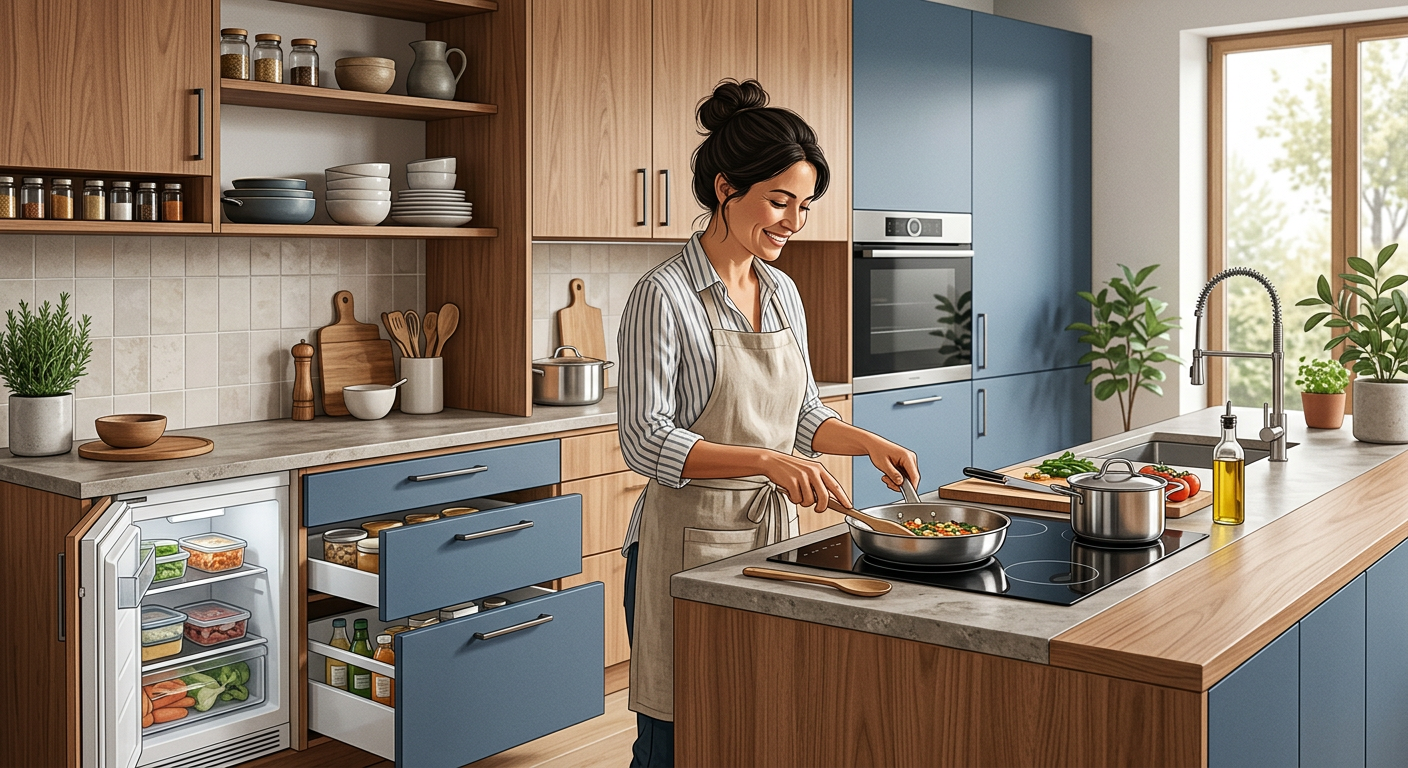
A kitchen is only as good as its hinges. Think about it: how many thousands of times will you open those drawers? Using modular drawers with soft-close mechanisms can actually make your cabinets last 40% longer. That’s a huge win for any kitchen renovation checklist. These custom kitchen fittings keep the “bones” of your modular kitchen planning from rattling apart.
And please, don’t let your corners die. Standard modular kitchen planning often leaves corners as “dead zones” where tupperware goes to be forgotten. Try these custom kitchen fittings instead:
- Magic Corners: Trays that slide out and “follow” you, bringing stuff from the deep back to the front.
- LeMans Corner: Swivel trays that swing completely out of the cabinet. Full access, zero crawling.
- Bottle Pull-outs: Slim cabinets for oils and vinegars—perfect for modular kitchen planning when you’re tight on space.
6. Layer Your Lighting for Function and Mood
Lighting is usually the last thing people think about, but it should be high on your kitchen renovation checklist. A single bulb in the middle of the ceiling is a recipe for shadows. You need three layers: Ambient, Task, and Accent.
Task lighting is the one you can’t live without. Under-cabinet LED strips shine light right where your knife is, making sure you don’t chop a finger off while cooking in your own shadow. This is a massive part of a functional ergonomic kitchen layout. Good modular kitchen planning always accounts for where the light hits the counter.
Ambient lighting sets the general vibe, while accent lighting (like lights inside your glass pantry unit designs) makes the room feel deep and expensive. For a deep dive into the technical side, check out the design standards we use at Visual Chase Interiors and Decor.
7. Prioritize Vertical Storage with Pantry Units
[PERSONAL EXPERIENCE] I once worked on a kitchen that felt tiny until we realized we were ignoring 7 feet of wall space above the counters. To really win at modular kitchen planning, you have to look up. A dedicated pantry unit design is the best way to handle your bulk groceries. Instead of stuffing bags of flour into five different drawers, keep them all in one tall unit—a classic move in any modular cabinetry guide.
Try a pull-out pantry where the whole rack slides out toward you. It’s one of the most brilliant kitchen furniture ideas for high-density storage. If your kitchen is small, take those cabinets all the way to the ceiling. [INTERNAL LINK: Smart pantry unit designs for small homes]
Moving the “dry goods” to a floor-to-ceiling pantry unit design frees up your bottom drawers for heavy pots and pans. It makes the daily workflow so much smoother.
8. Choose Sustainable and Eco-Friendly Materials
In 2024, modular kitchen planning isn’t just about the “look,” it’s about the air you breathe. Some old-school glues and laminates release nasty chemicals (VOCs) into your home. I always recommend low-VOC or zero-VOC finishes for your kitchen renovation checklist.
Sustainability is also about the wood itself. Using recycled wood or plywood from certified forests means your kitchen doesn’t cost the Earth. Since this is where you’re prepping food for your family, avoiding toxic off-gassing is just common sense. These kitchen furniture ideas are both stylish and responsible.
9. Future-Proofing with Smart Appliance Integration
The final piece of the modular kitchen planning puzzle is tech. The kitchen is becoming a smart hub. Even if you haven’t bought that fancy smart fridge yet, you should plan your modular cabinetry guide as if you have. It’s a vital way to future-proof your kitchen renovation checklist.
Think about adding:
- Power points hidden inside cabinets for charging tablets or using small custom kitchen fittings.
- A specific niche for a “Smart Hub” like an Echo to show recipes.
- Cabinet depths designed for the larger, smart-connected appliances coming out now.
- Wiring provisions for IoT dishwashers.
Building Your Perfect Modular Space
At the end of the day, great modular kitchen planning is where science meets art. When you master the Golden Triangle, pick BWP plywood over cheap alternatives, and get the ergonomics right, you end up with a space that’s a joy to be in. It’s the “hidden” things—those custom kitchen fittings and under-cabinet lights—that take a room from “okay” to “wow.”
At Visual Chase Interiors and Decor, we love turning these principles into beautiful realities. Whether you’re staring at a blank blueprint or you need a solid kitchen renovation checklist to fix an old space, we’re here to help. Let’s build something elegant together.
Ready to get started? Drop us a message on WhatsApp and let’s chat about your project!
We’re always sharing new ideas, so feel free to hang out with us on our socials:
Instagram |
Facebook |
YouTube |
Pinterest
Frequently Asked Questions
What is the most important rule in modular kitchen planning?
The Golden Triangle is the big one. By keeping the sink, stove, and fridge within 4 to 9 feet of each other, you create an ergonomic kitchen layout that saves your legs and makes cooking way more efficient.
Is BWP plywood better than MDF for kitchen cabinets?
Absolutely. For a kitchen, BWP (Boiling Water Proof) plywood is the gold standard. It won’t swell or rot when it gets wet, unlike MDF. It’s the best choice for long-term health in your modular cabinetry guide.
How can I maximize storage in a small modular kitchen?
Use your walls! Pantry unit designs that go all the way to the ceiling are lifesavers. Also, don’t ignore corners; use custom kitchen fittings like carousel units to turn “dead” space into usable storage.
What is the standard height for modular kitchen countertops?
The standard is usually 34-36 inches, but you should customize it. Ideally, the counter should be about 10-15cm below your elbow height so you don’t strain your back.
Why are soft-close mechanisms recommended for modular drawers?
They stop doors from slamming, which protects the hinges and the wood from getting beat up over time. It can add 40% more life to your cabinets—definitely a top item for your kitchen renovation checklist.
“`